Comparative Analysis of HICLOVER Waste Incinerators: Meeting Global Standards and Diverse Application Needs
Waste management is facing increasing scrutiny worldwide, demanding solutions that are not only effective but also compliant with stringent environmental regulations. **Waste incinerators** play a crucial role in this landscape, and choosing the right technology is paramount. This article provides a comparative analysis of HICLOVER **waste incinerators**, focusing on their compliance with international standards, certifications, and adaptability to various operational needs. The ability to meet stringent **medical incinerator operating temperature standards** is a crucial aspect of modern waste management.
Understanding Waste Incineration Principles and Regulatory Frameworks
The core principle behind waste incineration is thermal decomposition, reducing waste volume and destroying harmful pathogens. This process typically involves a primary combustion chamber, where waste is ignited, and a secondary combustion chamber, designed to ensure complete combustion of gases and particulate matter. Achieving optimal combustion requires precise temperature control and sufficient residence time. Regulatory bodies such as the World Health Organization (WHO) and the European Union (EU) have established emission standards that dictate permissible levels of pollutants released during incineration. These standards often specify limits for particulate matter, dioxins, furans, and other harmful substances. Temperature control is paramount; the secondary combustion chamber often requires temperatures above 850°C (1562°F) to ensure complete destruction of organic compounds. Meeting these standards is not merely a matter of compliance; it’s a commitment to environmental responsibility.
HICLOVER is growing brand for environmental protection field, and market share with most of Africa, Middle East, Southeast Asia countries and part of North America, Europe territory. We are trusted partner for governmental organizations, non-profit organizations, international contractors, logistics organizations, military, pet cremation business owners, etc. We have export experience more than 40 countries, including war zone like Iraq, Afghanistan, Somalia, South Sudan. Mobile: +86-13813931455(WhatsApp) Website: www.hiclover.com Email: [email protected] Email: [email protected]
Dual Chamber Design and High-Temperature Retention
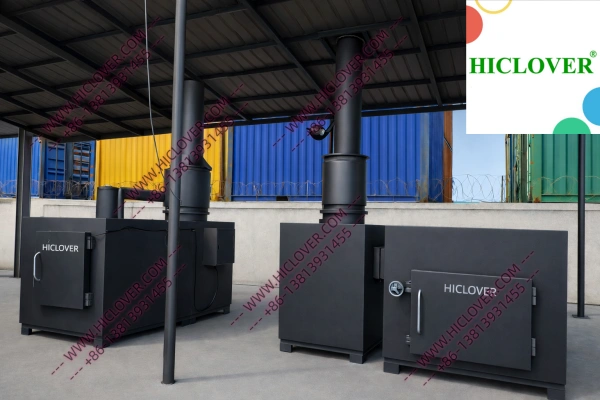
HICLOVER **waste incinerators** employ a dual combustion chamber design to ensure thorough waste destruction and minimize emissions. The primary chamber facilitates the initial burning of waste, while the secondary chamber focuses on combusting the remaining gases at high temperatures. This dual-chamber system is engineered for optimal **high temperature retention**, ensuring that harmful pollutants are broken down effectively. This design contributes significantly to achieving compliance with stringent emission standards. You can find more details about HICLOVER’s technology at [https://www.hiclover.com/](www.hiclover.com/).
Scrubbing Systems: Dry vs. Wet Scrubbers
To further mitigate emissions, HICLOVER offers both dry and wet scrubber systems as add-ons to their **waste incinerators**. Dry scrubbers typically use chemical reagents to neutralize acid gases, while wet scrubbers utilize liquid solutions to trap particulate matter and other pollutants. The choice between a dry and wet scrubber depends on the specific waste composition and emission requirements. Wet scrubbers are often more effective at removing a wider range of pollutants, but they also generate wastewater that requires treatment. Dry scrubbers, on the other hand, produce solid waste that needs to be disposed of properly. The selection process should carefully weigh the advantages and disadvantages of each technology.
Comparative Analysis of HICLOVER Incinerator Types
HICLOVER offers a range of **waste incinerators** designed to meet diverse needs, from small-scale medical facilities to large industrial complexes. These incinerators can be broadly categorized into fixed and containerized (mobile) units. Each type offers unique advantages and is suited for specific applications.
Fixed vs. Containerized Incinerators
Fixed incinerators are typically installed in permanent locations and are designed for high-volume waste processing. They are ideal for hospitals, large clinics, and municipal waste management facilities. Containerized, or **mobile incinerators**, on the other hand, offer greater flexibility and portability. These units are pre-assembled inside shipping containers, allowing for easy transportation and deployment to remote locations or temporary sites. **Mobile plug-and-play design** is a crucial feature.
The suitability for remote sites and the advantages of mobile modular systems are particularly relevant in today’s context of global infectious disease preparedness and crisis zones. HICLOVER’s **containerized modular systems** allow for rapid deployment of waste management solutions in areas where infrastructure is limited or non-existent. This is crucial for maintaining sanitation and preventing the spread of disease in emergency situations and humanitarian camps. Looking for more information on **small scale medical incinerator** options? Try this search: [https://www.google.com/search?q=small+scale+medical+incinerator](www.google.com/search?q=small+scale+medical+incinerator)
PLC vs. Manual Control Systems
HICLOVER **waste incinerators** are available with either Programmable Logic Controller (PLC) automation or manual control systems. PLC systems offer greater precision, efficiency, and data logging capabilities. They allow for automated temperature control, waste feeding, and emission monitoring. Manual control systems, while less sophisticated, are often more cost-effective and easier to maintain. The choice between PLC and manual control depends on the budget and technical expertise available at the operational site. **PLC controlled automatic waste Incinerator** options offer streamlined efficiency.
HICLOVER: Meeting Compliance, Certification and Regulatory Requirements
Compliance with environmental regulations is a critical factor in the selection of waste incineration technology. HICLOVER **waste incinerators** are designed to meet or exceed international standards, including those set by the WHO and EU. The company also holds various certifications, demonstrating its commitment to quality and environmental responsibility.
Certifications and Regulatory Adherence
HICLOVER adheres to stringent quality control processes throughout the manufacturing process. The company’s incinerators are designed and built to meet specific regulatory requirements of different countries and regions. This includes compliance with emission standards, safety regulations, and operational guidelines. Having **engineering experience** is crucial to ensure compliance.
Customization and Factory-Direct Supply
HICLOVER offers customizable chamber volumes and configurations to meet specific customer needs. As a factory-direct supplier, HICLOVER provides competitive pricing and ensures a **stable supply chain**. This eliminates the markups and potential delays associated with trading companies. The company’s **factory manufacturing capability** allows for greater control over quality and delivery timelines. HICLOVER has over 16 years of experience in the **waste incinerator** industry. HICLOVER offers incinerators for:
* Medical Waste * Animal Waste * General Solid Waste
Multi-Fuel Capability and Decentralized Waste Management
HICLOVER **waste incinerators** can be configured to operate on multiple fuel types, including diesel, LPG, and natural gas. This **multi-fuel** capability provides flexibility and ensures operational continuity in areas where fuel availability may be limited. Furthermore, HICLOVER promotes **decentralized waste management** through its mobile and modular incinerator systems. This approach reduces the need for long-distance waste transportation and minimizes the risk of environmental contamination. The pressure for **carbon emission reduction** is also a key factor.
In conclusion, HICLOVER **waste incinerators** offer a comprehensive solution for managing waste in a compliant, efficient, and environmentally responsible manner. Their diverse range of incinerator types, advanced control systems, and commitment to regulatory adherence make them a reliable choice for various applications.